
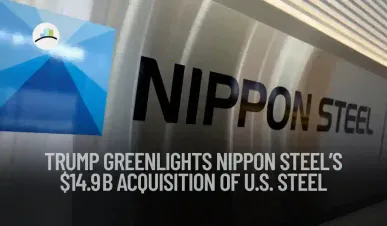
President Trump has signed an executive order approving the long-delayed acquisition of U.S. Steel by Japan’s Nippon Steel for $14.9 billion. The acquisition reverses former President Biden's veto, which was based on national-security and union concerns, and signals a major shift in U.S. industrial policy.
Government Holds "Golden Share"
The order includes provisions for a so-called "golden share," allowing the U.S. government veto power over key decisions—ensuring American control over strategic assets. Trump described this as “total control” and emphasized that U.S. Steel will remain an American company, even under Japanese ownership.
Investment, Operations, and Jobs
Under the agreement, Nippon Steel will invest $11 billion in U.S. Steel by 2028 and an additional $3 billion beyond that timeframe. The deal includes commitments to preserve U.S. Steel’s Pittsburgh headquarters, maintain U.S. leadership on the board, and uphold domestic manufacturing capacity.
Security Concerns Addressed
National security fears around foreign ownership of a strategic American producer have been mitigated through conditional clauses. These include federal oversight, board representation requirements, and preservation of domestic steel-making capabilities.
More Articles:
Market Reaction and Industry Impact
U.S. Steel shares initially rose on the announcement, though broader steel-industry sentiment remains mixed. Domestic automakers raised concerns about supply chain disruptions, while manufacturers welcomed the move as a boon for U.S. infrastructure and defense readiness.
However, questions remain over potential retaliatory tariffs and global trade tensions affecting steel pricing.
Political and Economic Significance
Trump's reversal aligns with his manufacturing-first agenda. It demonstrates executive power over foreign investment decisions and highlights the political importance of the U.S. steel sector—a traditional stronghold in swing states like Pennsylvania.
The golden share mechanism sets a precedent for future mergers involving foreign investment in strategic industries.
Communism is okay for MAGA. https://t.co/Ym8qHmVNP5
— rob (@487mph) June 14, 2025
What Happens Next
-
Nippon must satisfy federal security conditions before closing the deal.
-
Federal board oversight will begin, including golden share implementation.
-
Operational partnerships will drive domestic mill upgrades and job retention.
-
Regulatory bodies and trade partners will monitor progress and compliance.
-
U.S. Steel and Nippon Steel will launch investment programs aligned with government commitments.



