
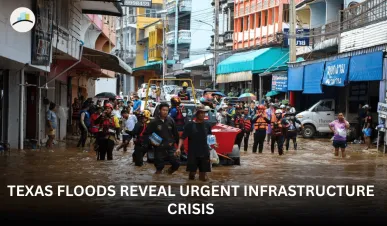
At least 24 lives have been lost and 23 young girls from a summer camp remain missing after catastrophic floods swept through parts of Texas this week. What initially appears as a tragic natural disaster quickly unfolds into a deeper crisis—of governance, climate preparedness, and infrastructure neglect.
While rescue operations continue and communities reel from grief, a critical question emerges: Why does this keep happening in Texas, and what can we learn before it happens again?
Distressed about the loss of life in Texas, where I live. But for those wondering why no preparation for flood, this is a map of the area 7/3/25, yesterday, showing EXTREME DROUGHT in the flood areas. It’s unexpected to go from extreme drought to lethal floods in a few hours. pic.twitter.com/xUXBNBqdqU
— August Rose (@Chuibluengold88) July 5, 2025
A Perfect Storm—But Not an Unforeseeable One
Meteorologists had flagged this event days in advance. The torrential rain was caused by a slow-moving, moisture-rich system pulling Gulf humidity inland. But experts argue the severity of the floods was exacerbated by decades of poor floodplain management and rapid, unregulated urbanization.
Texas has been one of the fastest-growing states in the U.S., but that growth has often come at the expense of natural wetlands, which once acted as sponges during heavy rain events. In short: we replaced nature’s buffer zones with concrete.
What’s Not Being Talked About Enough
1. Outdated Infrastructure and Local Liability
Most of the stormwater systems in flood-affected counties were built before 1980—and never upgraded. Cities like San Marcos and parts of Hays County have seen population booms, but budgets for water management haven’t kept pace. That disconnect now has a body count.
2. Summer Camps and Emergency Protocol Gaps
The fact that 23 girls from a summer camp are missing raises serious questions about how such facilities are licensed and whether they’re required to have robust evacuation or communication plans. In many states, outdoor camps fall under minimal regulation compared to schools or hotels.
3. Insurance Gaps and Economic Fallout
FEMA data shows that less than 20% of homes in flood-impacted zones were insured under the National Flood Insurance Program (NFIP). That means thousands of families now face displacement without compensation—deepening the economic wound, especially in low-income communities.
Historical Parallels and a Climate Lens
This isn’t an isolated incident. Hurricane Harvey (2017), the Central Texas floods (2015), and even the Memorial Day floods (2016) tell a repeated story. But with each event, the flood lines push further inland, affecting previously “safe” zones. This is a textbook example of climate creep—where yesterday’s 100-year floodplain becomes today’s annual event.
Dr. Renee Alvarez, a hydrologist at UT Austin, warns:
“Flood frequency models are outdated. Climate change is accelerating precipitation cycles, and Texas isn’t recalibrating fast enough.”
The Hidden Risk: Climate Migration and Policy Inaction
Texas continues to attract out-of-state migrants due to low taxes and a strong job market. But recurrent flooding is beginning to change that narrative. Some insurers are quietly withdrawing coverage in flood-prone zones, and real estate investors are reassessing property values in risk corridors.
Meanwhile, state-level resistance to enforce climate adaptation—such as stricter building codes or green infrastructure—may trigger a long-term policy backlash from younger voters who are demanding climate accountability.
More Articles:
Why This Is Important
This flood is not just a natural disaster. It is a warning siren. It underscores a widening gap between rapid development and resilient urban planning. It highlights how the most vulnerable—children, low-income families, uninsured homeowners—pay the highest price for systemic inaction.
If Texas is to continue leading in population, economy, and innovation, it must start leading in climate readiness too.



