
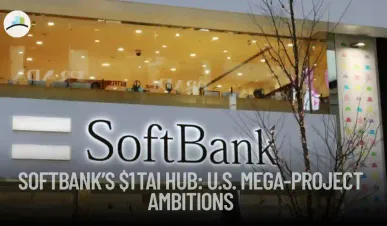
SoftBank founder Masayoshi Son is reportedly courting TSMC and the Trump team to build a $1 trillion AI-industrial complex in Arizona—a bold gambit that could redefine U.S. semiconductor and robotics capacity. But beyond the scale, this initiative hints at larger strategic narratives.
🧠 Why This Is Happening Now
-
Decades of Manufacturing Decline: Following offshoring, U.S. industrial capacity has weakened. Son’s proposal taps into political momentum for reshoring critical tech, offering a maize of solutions from robotics to chips—all anchored in one mega-complex.
-
Trump’s Marketplace Moment: The Trump administration, noted for preferences in domestic high-tech projects, could endorse this project as a signature win—mirroring his earlier support for “Stargate” ($500 billion AI data initiative).
-
SoftBank’s Financial Leverage: Riding high on its Vision Fund gains, SoftBank is now signaling intent: pivoting from venture capital to mega-industry creation, but the price tag demands innovative co-investment structures and incentives.
🔍 What’s Not Being Discussed Enough
-
TSMC’s Strategic Dilemma
As a foundry leader, TSMC risks alliance backlash from China. Arizona presents geopolitical safety—but also US policy pressure to localize chipmaking. Still unclear: whether TSMC wants or needs this complexity. -
Debt-Fueled Ambition Risks
Son’s prior "Stargate" project relies on massive debt (up to 90%)—and exposed financiers to leverage stress. Scaling that to $1 trillion could invite financing shortfalls or recession-triggered squeezes. -
Community & Ecosystem Creation
Beyond factories, Son’s project may aim to spark a new tech city—a hybrid of Shenzhen-meets-Palo Alto. That means planning infrastructure, housing, and R&D ecosystems—an urban-industrial gamble few private firms attempt.
Read More:
🌎 Political & Economic Implications
-
Economic Sovereignty Theater
The project embodies U.S. moves toward decoupling from China—driven by national security, subsidies, and geopolitical rivalry. If realized, it signals deep industrial reorientation. -
Labor Market Transformation
Workers' retraining in AZ could become a national testbed in advanced manufacturing. But misalignment between workforce skills and tech requirements remains a blind spot. -
Financial Market Ripples
If financed via bonds, debt issuance at this scale would reshape U.S. corporate debt markets. Success might prompt similar mega-project ventures; failure could sour appetite for industrial-scale private investment.
🔄 Historical Echoes
This ambition echoes Ford’s Rouge Complex in the 1920s or Japan’s post-war industrial clusters. But those were government-led. Here, the twist is a private mega-project courting public incentives, blending Silicon Valley aspiration with industrial park scale.
🎯 Hidden Risks & Opportunities
| Risk | Opportunity |
|---|---|
| Funding Gap – Raising $500 billion+ debt without clear cashflow contracts. | Tech Ecosystem Anchor – Could bootstrap next-gen robotics and AI firms regionally. |
| Geopolitical Blowback – TSMC's China ties complicate U.S. partnership. | Job Growth – Could create hundreds of thousands of STEM and blue-collar roles. |
| Urban Planning Failures – Infrastructure may lag industrial roll-out. | Diplomacy Dividend – Aligns with U.S.-Japan economic cooperation narratives. |
🏁 Why This Is Important
This isn’t just another tech announcement—it’s a blueprint for 21st-century industrial policy, merging private ambition with public strategy. Its success or failure could define whether megaprojects led by global capital can bypass bureaucratic inertia to incubate tomorrow’s industries.



