
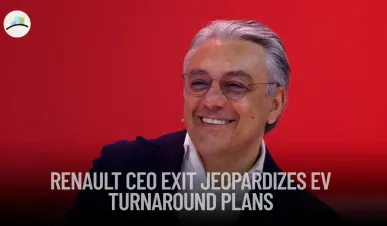
Renault’s turnaround story, once hailed as one of the boldest post-pandemic recoveries in the automotive world, is suddenly at risk of unraveling. The abrupt resignation of CEO Luca de Meo, who successfully navigated the French carmaker through one of its darkest chapters, leaves Renault exposed at a fragile moment — one where leadership stability was perhaps more critical than ever.
De Meo, who will exit by mid-July to join Kering SA, leaves Renault at a time when the company was poised to unveil a new midterm strategic roadmap that could define its next decade. His departure follows closely on the heels of CFO Thierry Piéton’s exit, marking a troubling double blow to Renault’s executive leadership.
The Hidden Risk: Leadership Vacuum Amid an Unfinished Transition
What is not being sufficiently discussed is how destabilizing this leadership gap could be, not just operationally but psychologically, for Renault’s global partnerships, its board, and investors. De Meo wasn’t simply executing a turnaround; he was the architect of a complete philosophical shift: downsizing the Nissan alliance, cutting costs, modernizing Renault’s model lineup, and aggressively pivoting towards electrification at a moment of unprecedented global competition.
His leadership departure threatens to derail Renault’s China strategy — a key pillar of its future — as well as fragile partnerships with Zhejiang Geely and other suppliers. These cross-border partnerships require trust and personal relationships at the highest level, something De Meo carefully cultivated.
Political Undercurrents: The French Government's Involvement
Complicating the situation further is the role of the French government, which still holds a 15% stake in Renault. With national pride and jobs at stake, political pressure will weigh heavily on Renault's board during its search for a successor. Unlike purely private companies, Renault must balance shareholder value with national industrial policy, adding another layer of complexity to what could be a protracted search for new leadership.
More Articles:
The Broader Industry Impact: Fragile EV Race & Chinese Competition
De Meo's exit also exposes Renault to mounting external pressures that he was uniquely equipped to navigate. The European EV market is increasingly crowded with aggressive Chinese entrants, while demand in Europe remains sluggish and volatile. Unlike Tesla or BYD, Renault's electrification shift is still heavily dependent on public incentives and subsidies — which may not remain indefinitely, especially as European governments face fiscal tightening.
The Quiet but Dangerous Geopolitical Angle
One under-reported aspect is Renault's increasing vulnerability to geopolitical shifts — not just Russia, where Renault already suffered losses after its exit, but potentially China too. As EU-China trade tensions rise and potential tariffs loom, Renault's fledgling Chinese ventures could face disruptions that would ripple across its global supply chain and profitability.
Investor Confidence: A Tipping Point Moment
The stark divergence in share price reactions — Renault down 6.7%, Kering up 9.5% — reflects more than just De Meo’s individual value; it reflects investor anxiety over Renault’s ability to maintain strategic continuity in an industry undergoing an existential transformation. Jefferies’ Philippe Houchois succinctly captured this by warning that Renault now stands "leaderless" at a critical inflection point.
The Unspoken Fear: Will Nissan Pounce?
There is also speculation, still unconfirmed but quietly circulating in financial circles, that Nissan may use this moment of instability to accelerate its own decoupling. Nissan is already exploring selling portions of its Renault stake, potentially taking advantage of Renault’s moment of vulnerability to strengthen its independence.
Bottom Line:
De Meo’s resignation is not just a personnel change — it's a potential breaking point in Renault’s fragile restructuring, raising risks that extend far beyond this quarter’s earnings. The automaker now faces a perfect storm of leadership uncertainty, geopolitical fragility, intensifying competition, and delicate government involvement — all while the clock ticks on its EV future.



