
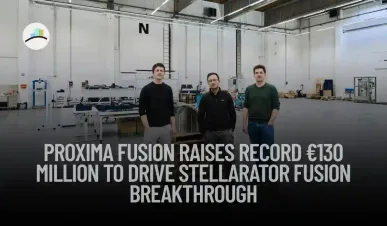
June 11, 2025 | Munich — Proxima Fusion, a spin‑out from Germany’s Max Planck Institute for Plasma Physics, has secured €130 million (about $149 million) in its Series A funding round — the largest private investment by any European fusion company to date. The new capital brings total funding to over €185 million and will help the company build a "Stellaris Model Coil" by 2027, followed by a demonstration power plant by 2031 .
charting a new course in fusion technology
Proxima Fusion is pursuing a stellarator-based reactor, an alternative magnetic confinement design to the more common tokamak. Stellarators use twisted superconducting magnets to confine plasma in a steady-state, potentially offering more stable operations compared to tokamaks, which rely on an internal plasma current and can experience disruptions .
Read More:
Europe has made significant scientific progress in this field, most notably through the Wendelstein 7‑X stellarator in Greifswald. That project has benefited from more than €1.3 billion in public investment and laid the groundwork for Proxima’s commercial ambitions .
strategic aspirations and technological milestones
Proxima Fusion has set out a clear roadmap:
-
Stellaris Model Coil by 2027 – to validate the performance of high-field superconducting magnets under realistic confinement conditions.
-
Demonstration plant by 2031 – a full-scale pilot, estimated to cost up to €1 billion, with the ambition of generating net electricity and paving the way for commercial deployment in the 2030s .
The company’s co-founder and CEO, Francesco Sciortino, described the model coil as a “magnet that changes history” and emphasized the importance of government partnership to bridge the funding gap to commercialization .
backing from investors and government
The Series A round was led by Cherry Ventures and Balderton Capital, both experienced deep‑tech investors. Filip Dames of Cherry Ventures called Proxima “a bet on Europe’s ability to lead in solving one of humanity’s biggest challenges,” while Daniel Waterhouse of Balderton cited the company’s strong physics and simulation expertise as key merit .
Germany's new conservative‑led government has also shown strong political support. Chancellor Friedrich Merz has endorsed the goal of hosting Europe’s first commercial fusion reactor, describing it as a potential major step in national energy innovation .
Europe’s fastest-growing nuclear fusion company raises $148 million in record funding round https://t.co/paEwbVyxqU
— Caleb McMurtrey (@CalebBMcMurtrey) June 11, 2025
funding context and broader fusion landscape
Worldwide, fusion startups are attracting increasing investor interest. In the United States, Commonwealth Fusion Systems raised $1.8 billion in 2021, and Helion secured $425 million early this year. Europe's Proxima, however, is closing the funding gap, and its €130 million raise marks a turning point for the continental fusion ecosystem.
Nevertheless, technical challenges remain significant. No fusion device has yet generated more energy than it consumes, and timelines to commercial power span decades. European governments including Germany, France, and the UK are discussing public-private partnerships to support these strategic ventures .
caution in a long journey
While Proxima’s advances and financial backing bring optimism, experts caution that fusion timelines are still long, and engineering challenges—such as producing large superconducting coils and scaling up systems—remain unresolved. The industry generally sets expectations around commercial viability in the late 2030s to mid-2040s .
Science and engineering must continue to converge. Proxima’s success will depend on regulatory approval, technical execution, and sustainable financing coordination between the public and private sectors.



