
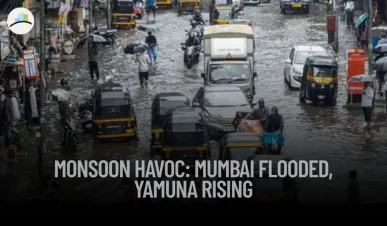
India’s financial capital, Mumbai, is reeling under an unprecedented deluge that has nearly paralyzed daily life. As of August 19, 2025, the city has witnessed continuous rainfall for over 72 hours, with several zones including Dadar, Sion, Matunga, Andheri, and Kurla receiving more than 500 mm of rainfall. The India Meteorological Department (IMD) has issued a red alert for Mumbai and surrounding districts, indicating the highest level of caution.
Educational institutions have been closed, offices have shifted to remote operations, and suburban train services—the city's lifeline—are disrupted across multiple routes. Local trains are either operating at reduced frequency or have been suspended on waterlogged tracks. Commuters have reported waist-deep water in station platforms and trains halted mid-journey.
More Articles:
Air travel is no exception. Flight operations at Mumbai’s Chhatrapati Shivaji Maharaj International Airport have been delayed or diverted due to poor visibility and runway flooding. Several airlines have issued advisories urging passengers to check flight status before heading to the airport.
What makes the current crisis more severe is the complete breakdown in urban mobility. Major roadways are submerged, with traffic snarled for hours. Emergency services are stretched thin as police, disaster response teams, and local volunteers have been rescuing people using inflatable boats in heavily waterlogged areas such as Kalwa, Chembur, and Bhandup.
Delhi Sounds Alarm as Yamuna Crosses Danger Mark
While Mumbai battles rising waters, the national capital is preparing for another kind of threat. The Yamuna River in Delhi has crossed the 205.33-meter danger mark for the first time this monsoon season. Authorities have moved into high alert mode, activating flood control rooms and preparing evacuation plans for vulnerable low-lying areas such as Yamuna Bazar, Kashmere Gate, and ITO.
While no large-scale evacuations have occurred yet, Delhi’s disaster management teams are monitoring the water levels closely. The Central Water Commission has indicated that additional inflows from upstream barrages could worsen the situation over the next 48 hours, particularly if rainfall persists in Himachal Pradesh and Uttarakhand.
Evacuation drills have been conducted in flood-prone neighborhoods, and temporary shelters with food, water, and medical aid are being set up as a precautionary measure.
Southern and Central India on Edge as IMD Issues Widespread Alerts
The IMD has also issued orange and red alerts across Andhra Pradesh, Telangana, Chhattisgarh, Karnataka, and parts of Goa. In Telangana, the Godavari River system is under close observation after heavy rains in the catchment areas. In Karnataka, the coastal districts including Udupi and Mangaluru are facing heavy inundation, with landslides reported in some hill regions.
Odisha and Chhattisgarh have initiated pre-emptive evacuation in districts with histories of flash floods. Relief camps have been activated, and National Disaster Response Force (NDRF) teams have been strategically deployed in vulnerable areas.
The Central and State governments are coordinating closely, but the widespread nature of the monsoon impact is pushing emergency services to their operational limits.
Mathura and the Yamuna: A Symbol of Overflow and Oversight
In Mathura, Uttar Pradesh, the Yamuna has already overflowed into key temple towns, causing panic among locals and tourists alike. Several ghats are submerged. Temples in the flood zone, including those in Vrindavan, have been temporarily closed. District officials attribute the flooding in part to a large-scale water release from the Delhi barrage without proper downstream coordination.
The incident has renewed long-standing concerns about India's inter-state river water management and the lack of cohesive monsoon preparedness between different regions.
The Bigger Picture: Urban Planning, Climate Volatility, and Policy Gaps
India's current monsoon crisis is not just a result of excessive rainfall—it is a failure of infrastructure, planning, and real-time crisis response. Urban centers like Mumbai and Delhi continue to rely on outdated drainage systems, unregulated construction over floodplains, and limited investment in disaster forecasting technology.
Climate change is adding volatility to monsoon patterns. What was once considered "unseasonal" is becoming the new normal. The intensity and frequency of heavy rainfall events have increased, placing additional pressure on civic systems not designed for such stress.
This crisis offers both a challenge and a wake-up call. India must now rethink its urban growth models, integrate climate-resilient infrastructure, and enforce stricter land-use planning. Without a systemic shift, monsoon devastation will continue to repeat itself—year after year—with greater intensity and cost.
Disclaimer
This article is based on publicly reported weather and disaster updates as of August 19, 2025, from multiple credible Indian news sources. It includes independent analysis and interpretation by Procapitas and is intended solely for informational and educational purposes. Readers are advised to follow official government advisories for real-time updates.



