
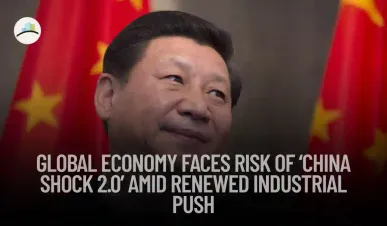
The world could be on the verge of experiencing another “China shock,” driven by China’s rapid advancement in high-tech manufacturing and green industries. This development echoes the massive economic upheaval caused by China’s industrial surge in the early 2000s but presents new challenges and opportunities for global markets.
Background: The Original China Shock
The term “China shock” describes the profound impact on global manufacturing and trade following China’s entry into the World Trade Organization (WTO) in 2001. China’s competitive export-driven manufacturing led to significant shifts in global supply chains, impacting labor markets and industries worldwide. Many countries experienced job losses in traditional manufacturing sectors as production moved to China.
Also Read:
China’s Renewed Strategy: Moving Up the Value Chain
Today, China aims to avoid the “middle-income trap” by investing heavily in advanced sectors such as electric vehicles (EVs), renewable energy technologies, semiconductors, and artificial intelligence. The “Made in China 2025” initiative exemplifies the country’s push to become a global leader in these fields. Unlike the low-cost manufacturing focus of the past, this phase emphasizes innovation and sustainability.
Key Economic Indicators
GDP Growth
China's economy posted stronger-than-expected growth in Q1 2025, with GDP expanding 5.4% year-on-year, outperforming forecasts. However, analysts caution that this momentum may be difficult to sustain due to escalating tariffs from the U.S., which cast a long shadow over global trade flows.
Electric Vehicles (EVs)
China continues to be the world's EV manufacturing hub, accounting for more than 70% of global production. In April 2025, China sold 1,226,000 new energy vehicles (NEVs), marking a 44.2% increase year-on-year. Exports of NEVs also reached a record 200,000 units in April, up 76% year-on-year.
New "Top News" post on CNBC: The world could be facing another 'China shock,' but it comes with a silver-lining: Cooler inflation https://t.co/DzB4gSwzey
— Street Hawk (@streethawk0) June 6, 2025
Semiconductors
In 2024, China's semiconductor market reached $344 billion, driven by investments in AI data centers and a recovery in the global chip market. The industry is expected to continue growing, with a projected compound annual growth rate of 7.31% from 2023 to 2027.
Renewable Energy
China's wind and solar power generation capacity surged to 1,482 gigawatts by the end of March 2025, exceeding fossil fuel-based thermal power capacity for the first time in its history. The country is set to account for over 25% of global energy investment in 2025, leading the world in clean energy investments.
Implications for Global Markets and Economies
This new wave of Chinese industrial growth may reshape global markets in several ways:
-
Trade Realignment: Countries may face intensified competition from Chinese high-tech exports, challenging domestic industries in Europe, the U.S., and emerging markets.
-
Supply Chain Shifts: Companies might restructure supply chains to balance reliance on China while navigating geopolitical tensions and security concerns.
-
Policy Responses: Governments could adopt protective measures such as tariffs, subsidies, or investment in domestic R&D to shield strategic sectors.
-
Investment Dynamics: Global investors may reconsider portfolio allocations to account for China's rising dominance in green technologies and high-tech manufacturing.
A Silver Lining: Opportunities for Collaboration
Despite concerns about market disruptions, there are positive aspects to China’s industrial ascent:
-
International Partnerships: Foreign companies can form joint ventures with Chinese firms, gaining access to technological advancements and the expanding Chinese consumer market.
-
Innovation Boost: Collaborative R&D efforts can accelerate progress in critical areas like clean energy and semiconductors.
-
Global Sustainability Goals: China’s focus on green technologies aligns with worldwide efforts to combat climate change, opening doors for multilateral cooperation.
Historical Lessons and Forward Outlook
The first China shock prompted painful adjustments but ultimately contributed to global economic growth and expanded markets. Similarly, the emerging “China shock 2.0” could foster new industries and innovation if countries adopt adaptive strategies. Balancing competition with cooperation will be essential to minimizing risks and maximizing benefits.
Source
CNBC – World could be facing another China shock — but there’s a silver lining



