
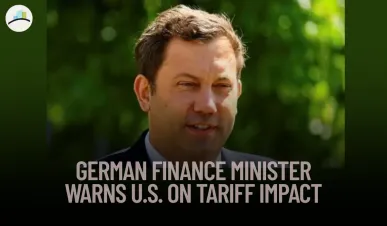
German Finance Minister Lars Klingbeil has issued a strong call for the United States to urgently work with the European Union in resolving a brewing tariff standoff, warning that failure to do so could lead to serious economic repercussions for both sides.
Speaking amid renewed threats from former U.S. President Donald Trump to impose a sweeping 50% tariff on EU imports by June 1, Klingbeil stressed that the responsibility for preventing a trade escalation lies equally with Washington. His comments come as trade tensions re-emerge following months of tentative diplomatic progress.
“It is not only in Europe's interest, but also in America's, to find a quick, constructive solution,” Klingbeil stated during a press conference in Berlin. “We are intertwined economies. Acting unilaterally would damage both sides.”
Germany’s High Stakes in Transatlantic Trade
Germany, as the largest economy in the European Union, is especially vulnerable to U.S. tariff hikes. The country exported goods worth approximately €161 billion ($175 billion) to the U.S. in 2024 alone. These include key industrial exports such as vehicles, pharmaceuticals, and precision machinery — many of which would be hit directly by the proposed tariffs.
According to Klingbeil, a tariff increase of this scale would disrupt long-standing supply chains and increase costs for American businesses and consumers alike. German officials fear that retaliatory trade barriers could spiral into a broader economic conflict, harming global trade stability.
A Recurring Trade Flashpoint
This latest flare-up in U.S.-EU trade tensions stems from President Trump’s broader campaign to rebalance trade terms with key U.S. partners. In early April 2025, Trump had threatened widespread tariffs on imports from virtually all countries. However, market reaction was swift and negative: the U.S. dollar weakened, and government bond yields dropped amid investor uncertainty.
The administration ultimately paused many of those tariffs in response to financial instability — but it left in place a 10% baseline import tax and moved forward with plans to enforce tougher penalties on Chinese goods. Most notably, duties on Chinese imports were adjusted from an initially proposed 145% to a still-substantial 30%.
The EU was given a temporary reprieve after European Commission President Ursula von der Leyen appealed to Trump in a direct call. A delay was granted, pushing the tariff enforcement date from June 1 to July 9 — offering a brief diplomatic window to negotiate terms. However, that window is rapidly closing.
A Call for Coordination — Not Confrontation
Klingbeil’s remarks were not only directed at the potential economic harm of tariffs, but also at the symbolism of a revived trade confrontation between democratic allies. He urged the U.S. to approach the matter with mutual interest in mind, rather than resorting to heavy-handed protectionism.
“It’s in neither side’s interest to create unnecessary economic uncertainty,” he said. “We need partners, not trade wars.”
The European Union has expressed readiness to negotiate and find solutions that respect both parties’ economic interests. However, EU officials have also warned they are prepared to respond with countermeasures if diplomacy fails.
What’s at Risk?
If implemented, the 50% tariff would likely hit a broad swath of European industries, particularly Germany's auto and manufacturing sectors. Analysts say such a move would not only disrupt transatlantic commerce but could also add upward pressure on inflation in the U.S., as tariffs tend to raise consumer prices.
Additionally, a trade war between the U.S. and EU — which together represent more than 40% of global GDP — could send negative shockwaves across global markets, already jittery from geopolitical instability and shifting interest rates.
For now, both sides remain engaged in behind-the-scenes negotiations. But the clock is ticking.
Disclaimer:
This article is intended for informational purposes only and does not constitute financial or legal advice. Readers are encouraged to consult with professional advisors before making any decisions based on economic or geopolitical developments. All statements are based on available data as of the date of publication.
Source:
Indian Express – German Finance Minister Says US Also Needs a Swift Tariff Solution
More Articles: