
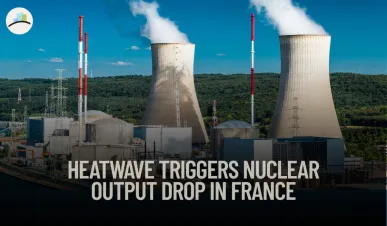
Heatwave Sparks Output Reductions at Key Nuclear Plants
France is experiencing a sharp increase in electricity prices after an early-summer heatwave triggered operational warnings at some of its major nuclear reactors. With temperatures rising above average across the Rhône and Garonne river valleys, water levels and cooling efficiency at several nuclear sites have been severely impacted. As a direct consequence, French utility giant EDF (Électricité de France) has begun to scale back output at its Bugey nuclear facility, with possible reductions anticipated at other sites including Cruas and Saint-Alban.
The issue stems from thermal discharge regulations. During hot spells, French law prohibits plants from discharging heated water into rivers beyond certain temperature thresholds, aimed at preventing ecological damage. When river water becomes too warm to effectively cool reactors without breaching these limits, operators must cut power generation. These measures have been activated as of late June, placing renewed pressure on a grid already contending with volatile energy demand and constrained hydroelectric supply.
More Articles:
Why France’s Grid Is Vulnerable to Summer Extremes
France's heavy reliance on nuclear power—about 70% of its total electricity generation—makes it uniquely exposed to environmental variables. Unlike gas or solar plants, nuclear reactors require a stable, cold water source for cooling, and most French plants draw from nearby rivers. Rising air and water temperatures have increasingly disrupted this balance over recent years, leading to recurring curtailments each summer.
The structural vulnerability is compounded by the age of France’s nuclear fleet. Many reactors were built in the 1980s and 1990s and are now showing signs of wear, including metal corrosion and maintenance delays. While EDF has committed to extending their lifespan, inspections, upgrades, and safety modifications have caused multiple outages in the past two years. This has left the grid with little spare capacity to absorb sudden output cuts due to weather.
Market Response: Power Prices Spike Across the Region
Spot electricity prices in France surged to their highest levels in over four months, reaching around €66 per megawatt-hour on the EPEX market. Traders are pricing in further increases if weather forecasts hold, especially in the Rhône valley where water stress is most acute. The ripple effects have already started to affect interconnected European markets, including Germany, Spain, and Italy—many of which rely on French exports during peak hours.
Although the weekend saw strong solar and wind output in northern Europe, it wasn't enough to fully offset the nuclear supply shortfall. Industrial users and utility hedgers are now moving to secure fixed contracts before any additional curtailments affect baseload capacity. Volatility in French day-ahead and intraday markets is likely to remain elevated as grid operators weigh additional restrictions tied to weather and environmental thresholds.
Long-Term Implications: A System in Transition
The current episode once again underscores the risks of overdependence on a single energy source—even one as reliable as nuclear in normal conditions. France is rapidly working to diversify its grid. The country has announced ambitious offshore wind targets, with 18 gigawatts of capacity expected by 2035. Additionally, a growing share of investments is being channeled toward green hydrogen, battery storage, and smart-grid technologies designed to reduce peak load stress.
Grid operators are also revising pricing incentives. New off-peak pricing structures and dynamic tariffs are being introduced to encourage demand shifting, particularly from industrial users. This is not just an energy issue—it’s a climate adaptation challenge, and it has financial implications for utility investors, corporate procurement managers, and national policy makers alike.
French month-ahead power prices rose after EDF warned that nuclear output could be cut at the end of June because of scorching weather https://t.co/tClt96NrM4
— Bloomberg (@business) June 25, 2025
Strategic Outlook for Investors and Policymakers
From a macro-financial standpoint, the current surge in French electricity prices could serve as an inflection point. Energy-intensive manufacturers may seek longer-term contracts indexed to renewable baseloads rather than spot nuclear rates. Meanwhile, EDF’s operational bottlenecks may draw further scrutiny from EU regulators and climate bodies, especially if emission levels rise due to backup fossil fuel generation during nuclear downtimes.
For policymakers, the heatwave disruption illustrates the need to integrate environmental risk more directly into energy planning. Nuclear power is low-carbon, but it is not climate-resilient in its current form. Advanced cooling technologies, more adaptive grid design, and a better mix of thermal and renewable sources will be essential for managing the grid through the 2030s and beyond.
Disclaimer:
This article is intended for informational purposes only and does not constitute investment advice. Procapitas does not provide personalized financial recommendations. Always consult a licensed financial advisor before making investment decisions. Information is based on publicly available sources as of June 2025 and Procapitas’ independent research and analysis.



