
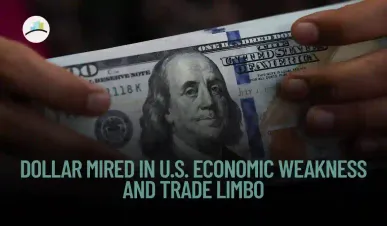
The U.S. dollar remained subdued on Friday, as mixed economic data and growing trade uncertainty continue to weigh heavily on investor confidence. The greenback’s latest slide comes amid stagnant job growth figures and speculation around potential policy shifts by the Federal Reserve.
Weak Job Data Casts Doubt on U.S. Economic Momentum
The U.S. Labor Department’s latest report showed that non-farm payrolls in May underperformed expectations, signaling a potential cooling in the labor market. While the unemployment rate remained steady at 3.9%, job creation slowed, reinforcing concerns about the durability of U.S. economic recovery.
Analysts believe the data could prompt the Federal Reserve to reconsider its policy stance in upcoming meetings. Slower hiring and declining consumer sentiment may give policymakers a reason to delay further interest rate hikes—or even consider cuts earlier than anticipated.
“We’re starting to see cracks in the labor market, and that’s fueling uncertainty around the Fed’s trajectory,” said Jane Foley, senior FX strategist at Rabobank.
Global Trade in Limbo Amid Tariff Tensions
Alongside domestic challenges, the dollar's struggles are compounded by international trade volatility. The recent tariff escalations initiated by the U.S.—including heightened duties on goods from China and Europe—have disrupted supply chains and rattled investor sentiment.
Sweden, Canada, and Mexico have all voiced concerns, while China’s latest round of rare earth restrictions have only intensified fears of a global trade decoupling. The U.S. dollar’s role as a safe-haven currency is being tested by these cross-border frictions.
Dollar mired in US economic weakness and trade limbo https://t.co/Y3yAQJyW8C #Financialthoughts
— Keith Churchouse (@onlinefinancial) June 6, 2025
Market Reactions and Currency Movements
The dollar index, which tracks the greenback against a basket of six major currencies, hovered near multi-week lows. The euro, yen, and pound all gained ground on the back of the dollar’s weakness, while emerging market currencies saw mixed performance.
-
The euro climbed to $1.0925.
-
The Japanese yen strengthened to 153.30 per dollar.
-
The British pound rose slightly, supported by domestic economic stability.
Meanwhile, gold prices surged past $2,370 an ounce as investors fled to safer assets amid rising uncertainty.
Outlook: More Pain Ahead for the Dollar?
The trajectory of the U.S. dollar depends largely on how the Federal Reserve responds to weakening economic indicators. With inflation cooling and job growth slowing, markets are pricing in the possibility of a rate cut by September.
Global economic decoupling and trade fragmentation will likely continue to pressure the dollar’s dominance, especially if multilateral tensions escalate further.
“Unless we see a clear reversal in data trends, the dollar may remain under pressure,” said Marc Chandler, Chief Market Strategist at Bannockburn Global Forex.
Source: Reuters - Dollar Mired in U.S. Economic Weakness and Trade Limbo



