
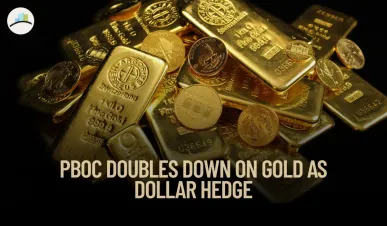
The People’s Bank of China (PBOC) has continued its aggressive gold-buying strategy for the eighth consecutive month, reinforcing a long-term play that goes well beyond simple portfolio diversification. The move comes at a time when central banks globally are rethinking the safety and utility of U.S. dollar reserves, and China appears to be positioning itself ahead of this geopolitical curve. With total gold reserves reaching approximately 73.8 million troy ounces (or around 2,290 metric tonnes), gold now constitutes roughly 5–6% of China’s total foreign exchange reserves.
More Articles:
The Bigger Play: De-Dollarization and Geopolitical Insurance
This sustained accumulation of gold by China isn’t just about diversification—it’s part of a broader strategic pivot. By reducing its dependence on U.S. dollar-denominated assets such as Treasury securities, the PBOC is insulating the country’s reserves against future sanctions or global monetary shocks. This approach mirrors Russia’s pre-Ukraine strategy, which also saw a swift shift into gold to protect national wealth from dollar-based financial systems that could be used as political tools.
China is also anticipating the possibility of its own financial assets being targeted due to growing tensions with the West. In this context, gold—an asset with no counterparty risk—provides not just financial protection, but geopolitical leverage.
Market Implications: Gold Buying Amid Record Prices
Remarkably, the PBOC has continued purchasing gold even as it trades near historical highs. This signals that China's strategy is long-term and largely price-insensitive. The current estimated purchase pace is about 60,000 troy ounces (roughly 1.9 tonnes) per month. This level of consistent buying has helped establish a strong floor under global gold prices and supports bullish momentum in the bullion market.
Gold also serves as a monetary policy tool for China. By converting excess foreign exchange reserves into gold, the PBOC effectively reduces the yuan’s appreciation pressure without overt market intervention. This tactic is particularly useful in managing the competitiveness of Chinese exports amid volatile global currency markets.
Risks: Price Peaks, Opacity, and Global Reaction
While China has room to expand its gold holdings, there are inherent risks. With gold already trading near its historical peak, continuous buying may look expensive on paper, especially if global interest rates start to rise again. However, China appears to be focusing more on strategic value than short-term price action.
Another concern lies in transparency. Much of China’s gold accumulation is believed to occur through indirect channels such as London or Hong Kong bullion markets. This lack of clarity often leaves global investors guessing the true scale of its purchases—potentially distorting global sentiment and triggering speculation-driven volatility.
There is also the risk of international backlash. Continued large-scale gold accumulation could be interpreted as a signal of waning faith in the U.S. financial system, possibly exacerbating geopolitical tension.
China added to its official gold reserves for an eighth straight month in June, as prices of the precious metal traded near a record high.https://t.co/JCVxosKToc
— Shehzad Younis شہزاد یونس (@shehzadyounis) July 7, 2025
Long-Term Vision: Gold as a Core Asset in China's Reserve Strategy
Most analysts agree that China is pursuing a long-term goal of having gold account for 10% to 20% of its total foreign reserves. With current gold holdings still around the 5–6% mark, China potentially has hundreds of tonnes left to accumulate in the coming years. If this trend continues, it could reshape global gold demand dynamics and challenge the existing order of reserve currency dominance.
China is also quietly building infrastructure to support this shift. Domestic insurance companies are now permitted to allocate a portion of their assets to gold, and gold ETFs are gaining popularity among institutional investors. These moves suggest a deliberate strategy to create both demand and structural support for a gold-centric financial buffer.
Disclaimer:
This article is intended for informational purposes only and does not constitute investment advice. Procapitas does not provide personalized financial recommendations. Always consult a licensed financial advisor before making investment decisions. Information is based on publicly available sources as of June 2025 and Procapitas’ independent research and analysis.



