
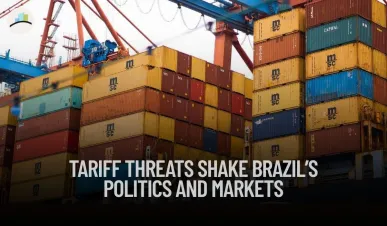
Brazil is facing sharp political and economic tremors following the U.S. threat to impose a sweeping 50% tariff on Brazilian exports. The announcement, tied by Donald Trump to judicial proceedings against former President Jair Bolsonaro, has triggered not only a diplomatic standoff but a major political recalibration within Brazil itself.
President Luiz Inácio Lula da Silva, often criticized by the business community for his regulatory stance, has unexpectedly found support from typically conservative business sectors. This alignment stems not from ideological shifts but from a shared concern: the belief that trade policy is being used as political retaliation. With the August 1 tariff enforcement deadline approaching, Lula has positioned himself as a defender of national sovereignty, garnering popular support in the process.
More Articles:
Lula Gains Momentum by Framing Tariffs as Sovereignty Threat
Rather than being politically weakened by U.S. pressure, Lula has capitalized on the moment. In speeches and public interviews, he’s framed the tariff threat as a matter of Brazil’s dignity and independence. His rhetorical stance—emphasizing that “Brazil does not take orders from foreign leaders”—has played well among working-class voters and nationalist-leaning groups.
Pollsters have reported a measurable rise in Lula's approval ratings since early July. The unexpected show of support from centrist industrial leaders has also helped reinforce his image as a pragmatic, globally-minded leader rather than a doctrinaire leftist. As election season nears, this episode may serve as a pivot point that recasts Lula’s political narrative from defensive governance to assertive statesmanship.
Brazilian Exporters Face Sharp Disruption Amid Rising U.S. Trade Barriers
The economic consequences, however, are already unfolding. Brazilian exporters, particularly in agriculture, chemicals, and industrial goods, are reporting widespread cancellations and delays in U.S.-bound shipments. Some contracts are being revised with force majeure clauses, while others are simply withdrawn.
In sectors like pulp and paper, meat processing, and steel manufacturing, businesses are beginning to model the impact of prolonged U.S. import restrictions. Even aerospace firms such as Embraer are seeing their forward-looking deal pipelines threatened, with North American partners pressing pause on capital-intensive deals.
Major agribusiness firms are bracing for a second-order effect: if exports remain blocked for more than a quarter, inventories will surge, prices will fall domestically, and margins will compress. The broader impact on Brazil’s trade balance could create fiscal stress heading into a sensitive political cycle.
Currency, Bond Markets Signal Mounting Investor Uncertainty
Financial markets in Brazil have not waited for the tariffs to become official. The Brazilian real depreciated more than 2% against the U.S. dollar over the past week, a clear signal of risk-off sentiment. Meanwhile, long-term government bond yields have climbed, reflecting higher perceived political and credit risk.
Notably, the Brazilian central bank and securities regulators have begun investigating large currency trades made just days before the U.S. tariff announcement. Early signs suggest that some institutional players may have adjusted FX positions based on advance knowledge—raising concerns about market integrity.
Retail investors are showing early signs of repositioning as well. Domestic equity funds have seen small but consistent outflows, while flows into sovereign bond ETFs and USD-hedged instruments have picked up. Private banks have reported an uptick in clients asking for capital preservation strategies, a signal that investor confidence is being tested.
At a large financial market gathering in Sao Paulo, Donald Trump’s threat to impose 50% #tariffs on Brazil barely registers as a primary #economic concern https://t.co/l7d76B1Q0G
— Sharity (@Sharity) July 25, 2025
Strategic Insight — Brazil’s Election May Now Center on Trade Sovereignty
The underlying story is not just about tariffs; it’s about political positioning. The trade threat has catalyzed a realignment in Brazilian political discourse. Opposition parties that traditionally advocate free enterprise are now seen as aligned with U.S. interests, while Lula is rallying support by pushing a national-first agenda.
This shift could prove decisive in shaping the 2026 presidential race. If Lula continues to own the narrative of defending national autonomy while simultaneously managing investor risk, he could solidify a broad coalition that includes even moderate voters wary of economic instability.
For global investors, the message is clear: Brazil’s market is now a battleground not just for trade, but for ideas around sovereignty, fairness, and economic nationalism. That tension is likely to continue producing volatility in both markets and policymaking for months ahead.
Disclaimer:
This article is intended for informational purposes only and does not constitute investment advice. Procapitas does not provide personalized financial recommendations. Always consult a licensed financial advisor before making investment decisions. Information is based on publicly available sources as of June 2025 and Procapitas’ independent research and analysis.



