
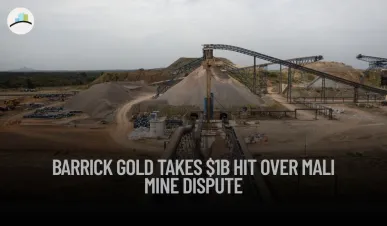
Barrick Gold Corporation, the second-largest gold miner in the world, is facing one of its most serious operational and financial challenges in recent years. The company has recorded a $1 billion net charge in its latest financial disclosures, directly linked to a high-stakes dispute with the government of Mali over its flagship Loulo-Gounkoto gold mine.
More Articles:
This situation marks a critical flashpoint not only for Barrick's future in West Africa but also for broader investor confidence in the region’s mining sector. With geopolitical tensions rising and regulatory frameworks becoming more unpredictable, the case offers a cautionary tale of how resource nationalism and changing tax regimes are shaking up global mining economics.
How the Conflict with Mali Escalated
The roots of the current dispute trace back to Mali’s 2023 revision of its mining code. The new laws significantly altered the operating environment by expanding the government’s stake in new mining projects, increasing royalties, and adding export taxes. While these changes were intended to increase state revenues and better regulate mining activity, they clashed with longstanding agreements signed by firms like Barrick under previous legal frameworks.
Barrick has operated the Loulo-Gounkoto complex under a 1991 mining convention that predated the regulatory overhaul. Citing legal protections under that agreement, the company resisted the changes and continued exporting gold under the original tax regime.
The turning point came when the Malian government seized approximately three metric tons of gold in early 2025, citing unpaid dues under the new laws. In response, Barrick suspended operations at the mine — a facility that accounted for nearly one-fifth of its annual global output — and removed its contribution from the 2025 production guidance.
Financial Ramifications for Barrick
The fallout has been dramatic. The $1 billion charge includes expected asset impairments, lost production value, legal costs, and devaluation of local assets. This write-down significantly affected Barrick’s quarterly earnings and investor sentiment, sending its stock into decline and amplifying volatility across the gold sector.
Barrick CEO Mark Bristow, who has previously been credited with navigating high-risk jurisdictions, is now under pressure to protect the firm’s African portfolio while balancing investor expectations. The company maintains it is actively engaged in diplomatic and legal processes to resolve the issue.
Legal Actions and Arbitration Efforts
Barrick initiated arbitration through international legal channels, arguing that Mali’s unilateral changes violate prior contractual rights and bilateral investment treaties. However, its attempts to suspend Mali’s local court actions were denied by the World Bank’s arbitration body. Adding to the complexity, a Malian court appointed a provisional administrator to oversee the mine's assets, a move Barrick has vowed to appeal.
This marks a worrying precedent. For investors, it raises questions about the sanctity of investment contracts in regions with fluid political environments. For host nations, it reflects the growing tension between national development goals and attracting foreign investment.
Broader Context: Resource Nationalism and Mining Sector Pressures
This isn't just a Barrick-Mali issue — it’s a reflection of broader shifts in global resource politics. As developing nations seek greater control over their natural resources, many are rewriting mining laws, increasing royalties, and asserting more authority over foreign operators. From the Democratic Republic of Congo to Latin America, mining majors are being forced to renegotiate terms or face operational shutdowns.
In this climate, Barrick’s troubles in Mali may influence how other miners structure their risk models in similar jurisdictions. Investors are watching closely to assess how much leverage governments may wield before they drive away crucial foreign capital.
Barrick slumped in pre-market trading after the posting a net charge of $1.04 billion related to the seizure of its vast Loulo-Gounkoto #gold complex by Mali’s military junta.https://t.co/tKAMJHUWSw pic.twitter.com/hBagHQkzMf
— JennyManyDots (@jenstilmanydots) August 11, 2025
Conclusion
Barrick Gold’s $1 billion charge is not just a number on a balance sheet. It represents a breaking point in one of its most strategic African operations and highlights the fragile equilibrium between mining firms and host nations. As the legal and diplomatic battles unfold, the company’s ability to recover from this blow — or at least prevent similar issues elsewhere — will be closely scrutinized.
At a time when global gold prices are being shaped by geopolitical uncertainty, inflation fears, and central bank purchases, the disruption of a major gold supply source like Loulo-Gounkoto adds a layer of complexity to the commodity’s outlook.
Barrick’s future in Mali — and perhaps other high-risk, high-reward geographies — now depends on its ability to find common ground amid changing political and legal landscapes.
Disclaimer:
This article is for informational purposes only and does not constitute investment advice or a recommendation to buy or sell any securities. Procapitas does not provide personalized financial advice. All investment decisions should be made in consultation with a licensed financial advisor. The information presented is based on publicly available sources and Procapitas’ independent research and analysis, which are believed to be reliable but are not guaranteed for accuracy or completeness.



