
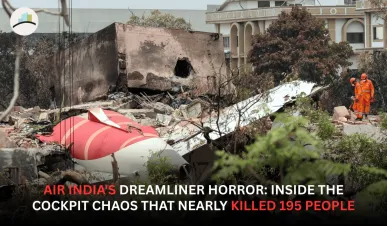
A Routine Landing That Became a Disaster
It was supposed to be a routine touchdown — a long-haul Boeing 787 Dreamliner flight arriving in San Francisco after nearly 16 hours in the sky. But in a matter of seconds, Flight AI185 morphed from a picture of modern aviation to a chilling near-disaster. The jet skidded off the runway. Metal screeched. Tires burst. The aircraft tilted violently. And 195 lives hung in the balance.
Yet somehow, everyone survived.
But now, as the audio from the cockpit emerges and global regulators dig deeper, a far more unsettling truth has surfaced — one that isn’t about mechanical failure, but human failure in an era of overengineered safety.
Preliminary report for Air India is out. Here are main excerpts:
— aircraftmaintenancengineer (@airmainengineer) July 11, 2025
- 08:08:42: Engine 1 and Engine 2 fuel cutoff switches transitioned from RUN to CUTOFF position one after another with a time gap of 01 sec
- In the cockpit voice recording, one of the pilots is heard asking the… pic.twitter.com/GuOetCXOBW
What Went Wrong in the Sky?
The cockpit exchange during those critical final minutes read less like a checklist-driven routine and more like a confused, distracted debate under pressure. The captain and the first officer — both experienced but clearly overwhelmed — miscommunicated crucial landing configurations. Key safety protocols were skipped. Auto-throttle issues went unaddressed. And crew resource management (CRM) broke down entirely, leaving the aircraft vulnerable just when precision was most needed.
While Boeing’s sophisticated automation tried to compensate, human error spiraled. Seconds later, the Dreamliner slid off the runway.
This Wasn’t a One-Off. It Was a Red Flag.
Air India’s flight AI185 didn’t just expose a moment of cockpit confusion — it ripped open a wider aviation fault line: modern pilots are increasingly flying planes they no longer fully command.
We trust aircraft automation more than ever. But when systems fail or decisions need to be made on instinct, are today’s pilots ready?
The answer, in this case, was: no.
MORE ARTICLES:
The Silent Crises No One’s Talking About
1. Pilot Overreliance on Automation
In the Dreamliner’s highly digital cockpit, decisions are often delegated to machines. But automation breeds complacency. The more systems think for us, the less we practice thinking ourselves.
This flight showed how even highly trained crews can become dangerously deskilled — trusting the system blindly, instead of truly flying the plane.
2. Pandemic-Era Training Gaps Resurface
Post-COVID aviation has a dirty secret: thousands of pilots returned to cockpits after long furloughs, often with limited retraining. Some had reduced simulator hours. Others had patchy flight time.
AI185 may be the first serious public consequence of this silent risk.
3. Air India's Ambition May Be Outrunning Its Safety Culture
With Tata Group at the helm, Air India is in the midst of an unprecedented global expansion: hundreds of new aircraft ordered, dozens of new routes launched. But behind that ambition lies a burning question:
Has the airline scaled its crew training, governance, and safety oversight at the same speed?
This incident suggests the answer is: not yet.
The Business Fallout Has Just Begun
-
For Air India & Tata: As the flagship carrier attempts a historic rebrand, this incident may tarnish its reliability. Lawsuits, regulatory probes, and dented public trust could follow.
-
For Boeing: Another 787 incident — even if not directly the plane’s fault — may invite renewed scrutiny. The 737 MAX shadow still lingers.
-
For Insurers: Premiums for long-haul international routes, especially from rapidly expanding carriers, are expected to rise.
A Grim Déjà Vu: Echoes of Air France 447
In 2009, a highly automated Airbus A330 fell into the Atlantic after pilots misread instruments and lost control. That tragedy killed 228 and exposed the dangers of automation dependence and poor CRM.
Flight AI185 is different — but hauntingly similar. The difference this time? We still have survivors who can testify.
What Experts Fear Most
Aviation analyst Richard Aboulafia put it starkly:
“You can’t outsource cockpit judgment to computers — yet. Human factors remain the weakest link.”
And that link is fraying faster than many realize.
Hidden Threat: Regulatory Fatigue
As global fleets grow, regulators struggle to keep pace. Aircraft are more complex. Routes are more crowded. But oversight? It’s thinning. The NTSB has launched an investigation — but will other authorities follow?
And if not, what does that say about how many more warning signs we’re willing to ignore?
Final Thought: The Alarm That Must Be Heard
The miracle of AI185 was that no one died.
But it was no fluke. It was a red flag — torn and waving in the slipstream of a modern aviation industry flying ever faster into complexity. Without a reset in how we train pilots, manage automation, and scale safety with growth, the next incident may not be so forgiving.



